How to Spot a Fake Pokémon Card: A Collector's Guide to Authentication
Meta Description: Learn how to spot a fake Pokémon card in seconds. This collector's guide covers the light test, texture checks, font details, and more to protect your collection.
Counterfeit Pokémon cards have flooded the secondary market over the past few years, and they've gotten good — good enough to fool casual collectors and, occasionally, even experienced ones at a quick glance. Whether you're buying a booster box off a marketplace, picking up a graded rare from a private seller, or inspecting a card a friend just pulled, knowing how to authenticate a Pokémon card is one of the most valuable skills you can have as a collector.
This guide walks through the checks real collectors and dealers use to separate genuine cards from fakes, starting with the fastest tests and moving into the finer details.
Why Fake Pokémon Cards Are So Common
The Pokémon TCG's booming secondary market has made counterfeiting profitable, especially for high-value chase cards like Charizard, Umbreon VMAX, and other sought-after rares. Counterfeiters typically target:
- High-value single cards sold outside of sealed packaging
- Bulk "lots" of rares sold at prices that seem too good to be true
- Sealed-looking products from unofficial or unverified sellers
Pokémon has even flagged this directly, warning collectors that a price dramatically below suggested retail is a near-certain sign of counterfeit merchandise.
Because fakes are made to imitate the most desirable cards, the best defense is knowing exactly what a genuine card looks, feels, and reacts like. If you want to browse verified genuine booster boxes or Elite Trainer Boxes while you shop, every listing in our store has already passed this kind of check.
1. The Light Test
This is the fastest and most reliable test for most fakes.
Hold the card up to a bright light source, ideally a flashlight or phone light held directly behind it.
- Genuine cards have a black layer in the middle of the cardstock. This layer blocks nearly all light from passing through, so the card appears almost completely opaque.
- Fake cards are usually printed on standard cardstock without that black core layer, so light will shine through clearly, often showing the card's image or text as a silhouette.
If light passes through easily, the card is almost certainly counterfeit. Pokémon's own support team recommends this exact method as one of the fastest ways to catch a fake.
2. Check the Texture and Card Stock
Genuine Pokémon cards have a distinct texture:
- A slight, fine texture on the surface, especially noticeable on the card's border and text
- A rigid, snappy feel when flexed gently — genuine cards don't feel flimsy or overly glossy
- A consistent thickness that matches other cards in your collection
Fakes often feel smoother, glossier, or noticeably thinner or thicker than authentic cards. If you have a genuine card of the same era on hand, compare them side by side.
3. Inspect the Font and Text Details
Counterfeiters frequently get small text details wrong, since official fonts and spacing are proprietary and hard to replicate exactly.
Pay close attention to:
- The energy symbol font — genuine cards use a specific, consistent typeface for HP, attack costs, and card text
- Spacing and alignment — fakes often have text that's slightly misaligned, too bold, too thin, or unevenly spaced
- The copyright line at the bottom of the card, which should match the correct set year and formatting exactly
If anything about the text looks "off" compared to a verified genuine card from the same set, treat it as a red flag.
4. Look at the Card Back
The backs of counterfeit cards are often a giveaway:
- Genuine card backs have a rich, deep blue color with crisp detail on the Poké Ball artwork
- Fakes frequently show a lighter, duller blue, or slightly blurred artwork
- The border on genuine cards is evenly sized on all sides; fakes sometimes have uneven or slightly shifted borders
5. Check Color Saturation and Print Quality
Hold the card next to a verified genuine card under natural light.
- Genuine cards have rich, accurate colors that match official artwork
- Fakes often appear washed out, oversaturated, or slightly off in hue, especially in energy symbols and holographic sections
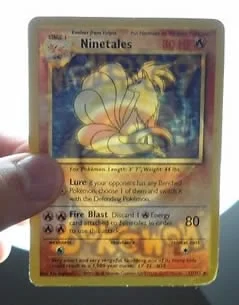
6. Examine the Holo Pattern (For Holographic Cards)
Holo patterns are one of the hardest things for counterfeiters to replicate accurately.
- Genuine holo cards have a consistent, official pattern (such as the cosmos or sun-and-moon pattern used across various sets) with clean, sharp reflectivity
- Fakes often use a generic, overly shiny, or "rainbow" holo effect that doesn't match the actual pattern used for that specific set and era
If you're familiar with the correct holo pattern for a given set, this test alone can catch most fakes quickly.
7. Use the Card Size and Weight Test
Genuine Pokémon cards are manufactured to a precise, standardized size and weight. If you have a scale and a caliper (or a genuine card to compare against):
- Compare the exact dimensions — fakes are sometimes a millimeter or two off
- Compare weight — counterfeit cardstock is often noticeably lighter or heavier
8. Get High-Value Cards Professionally Graded
If you're investing in an expensive single card, third-party grading adds another layer of protection. Services like PSA authenticate and grade cards before encapsulating them, giving you a verified record of both condition and authenticity — something that matters if you ever plan to resell.
9. Buy From Verified, Authenticated Sources
The most reliable way to avoid fakes altogether is to buy from sellers who authenticate their inventory before it ships. Sealed products, in particular, should always come from trusted suppliers rather than unofficial resellers offering prices well below market value.
At FindHive, every booster box, Elite Trainer Box, and single card is sourced from vetted suppliers and checked for authenticity before it reaches your cart — so you can focus on collecting, not second-guessing what arrived in the mail. You can also browse our 30th Anniversary Collection for verified reprints and exclusive sets.
Final Thoughts
No single test is 100% foolproof on its own, but combining two or three of these checks — especially the light test, texture check, and holo pattern inspection — will catch the overwhelming majority of counterfeit Pokémon cards. When in doubt, compare against a verified genuine card, and when buying online, stick to sellers who stand behind the authenticity of what they sell.
Looking to grow your collection with confidence? Shop verified, authenticated Pokémon TCG products at FindHive, or check out our FAQs if you have questions about an order.